
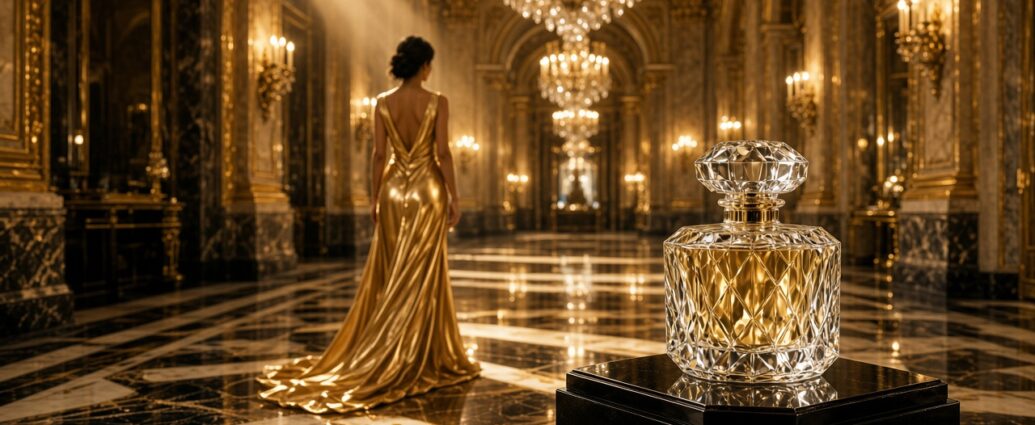
Luxury does not sell a bottle, a bag or a watch. It sells a woman you want to become — or stand beside. The great houses have known this for a century.
Walk through any European duty-free gallery and the pattern is immediate. A flacon the size of a fist. A gown that costs more than the perfume. A woman who does not look at the camera so much as allow it to exist in her world. The product sits in the corner of the frame. The desire takes up the rest of it.
This is not an accident of taste. It is one of the oldest commercial bets in luxury: that a certain kind of woman, placed in a certain kind of light, will make a customer reach for a card they had not planned to use.
The two women luxury keeps casting
In the 1990s, the American semiotician Laura Oswald studied thirty high-end perfume brands, including Chanel, Dior, Lancôme and Yves Saint Laurent. The Conversation later set out her finding: the advertisements were not really about juice. They were about two rival ideas of femininity. One was the “goddess” — admired, slightly unreal, placed in a dreamlike space with no ordinary human clutter. The other was the “girl next door,” shot tighter, often in black and white, looking like a life you could almost step into.
Both are selling identification. The goddess makes you want to ascend. The girl next door makes you want to belong. Either way, the customer is not being asked to compare top notes. They are being asked to try on a self.
Ipsos, in its work on luxury and advertising, has been blunt about the rule behind those images. The benefits, it argued, “must always be emotional and sensual and never rational.” Fauchon sells a gourmet experience, Hermès a kind of freedom, Dior a kiss of sensuality — “but always reinforced by status and elitism.” The great campaigns, Ipsos added, invent worlds that belong to the brand more than to the product: the gold pool of Dior’s J’adore, the tribal theatre of Dolce & Gabbana. A bottle cannot do that work alone. A woman in the frame usually can.
Luxury advertising does not argue. It invites you into a world, and a woman is very often the door.
Why the brain pays attention
A 2020 review in Current Opinion in Psychology put the wider mechanism in colder language. The desire for luxury, the authors wrote, largely derives from the need for status — “respect, admiration, and voluntary deference” — and status “leaks” from valued signals to the people who carry them. Place a recognised woman beside a watch, a bag or a scent, and some of her charge travels with the object. The customer is not only buying a thing. They are borrowing a glow.
That is why the houses still spend like film studios on a face. It is also why a house ambassadorship can matter as much as a single campaign image. We have already followed Amanda Seyfried’s arrival as a Tiffany & Co. house ambassador: the jewel is the alibi, the woman is the invitation.
The campaigns that became folklore
The most famous proof did not even begin as a paid endorsement. In 1954, Marilyn Monroe was asked what she wore to bed and answered, in the line that has been retold for decades, that it was just a few drops of Chanel No. 5. Les Echos has described how the house later built a campaign around that recording. The scent borrowed her glamour; the glamour made the scent feel inevitable. A paid contract, in that instance, was almost beside the point.
When Jacques Helleu reshaped Chanel’s advertising in the 1970s, he went back to that Hollywood current. Catherine Deneuve became the face of No. 5, photographed by Richard Avedon: often just her face, the bottle, her name and the brand. No slogan. No hard sell. The woman was the copy.
Three decades later the house turned the idea into a short film. In 2004, Baz Luhrmann directed Nicole Kidman in Chanel’s No. 5 film. The Guardian, that November, reported that the two-minute commercial had cost about £18 million. The Sydney Morning Herald, citing other industry figures, put the production as high as $42 million. Guinness World Records later listed the film among the most expensive television advertisements, citing a production cost of $33 million, and recorded Kidman’s fee for the campaign at $3.71 million. The numbers differ by source, and should be read as reported, not as a single audited total. What none of them dispute is the scale of the bet: a movie star, a film director, and a perfume treated as a world premiere.
Dior made a similarly long wager with Charlize Theron. J’adore launched in 1999 with the Estonian model Carmen Kass as its first face, in a teardrop bottle designed by Hervé Van der Staeten to suggest a female silhouette. Harper’s Bazaar has described how Theron, from 2004, became almost inseparable from the scent, walking through gold as if the fragrance had a body. La Libre, marking a decade of the partnership in 2016, noted that J’adore had even unseated Chanel No. 5 as the best-selling fragrance in 2011. A woman, repeated with enough style, can outlast a season and rearrange a market.
The invitation, not the argument
This is why the female figure in a luxury advertisement is not decoration. She is the access point. European houses already allocate their rarest objects as if they were invitations rather than stock, a shift we have traced in our report on invitation-only allocation. The woman in the campaign is doing similar work in public. She is the living door to a world the house would like you to believe is almost closed.
When fame itself becomes equity — a subject we have examined in our look at celebrity stock holdings — the face on the campaign is no longer just a muse. She is a tradable signal. Global Celebrity Meter has set out how the market prices a famous name, and what it actually takes to become a mega star whose image can carry a house. Celebrityfees has asked why sex appeal still moves pop culture. The luxury maison simply got there first, and dressed the transaction in silk.
The critique that will not go away
There is a sharper reading, and it should be named. Oswald’s study, as The Conversation summarised it, also found that many of these feminine types were archaic: goddess, temptress, princess. The advertisements can flatten women into an ideal a customer is meant to chase. That tension has not disappeared, which is why some houses now widen the cast or age the face. EuroCelebs has already asked whether even the hourglass crush is a worldwide setting. The strategy evolves. The commercial bet does not: a woman in the frame still does more work than a paragraph of product claims.
What it means for the houses
If the woman is the brand world, she has to be chosen with the same care as a creative director. The wrong face is not a weak media buy. It is a cracked myth. The right one, held for a decade, can make a flacon feel like an heirloom — the same logic that turns a numbered object into a lasting allocation, whether that object is a watch in the vault or a ritual in our everyday vitality brief.
The spell is easier to see than to resist. You are not being asked whether the jasmine is well made. You are being asked whether you want to walk down that corridor in gold. That is why women in luxury ads still attract customers. They do not explain the product. They make you want to enter the picture.


1 Comment