
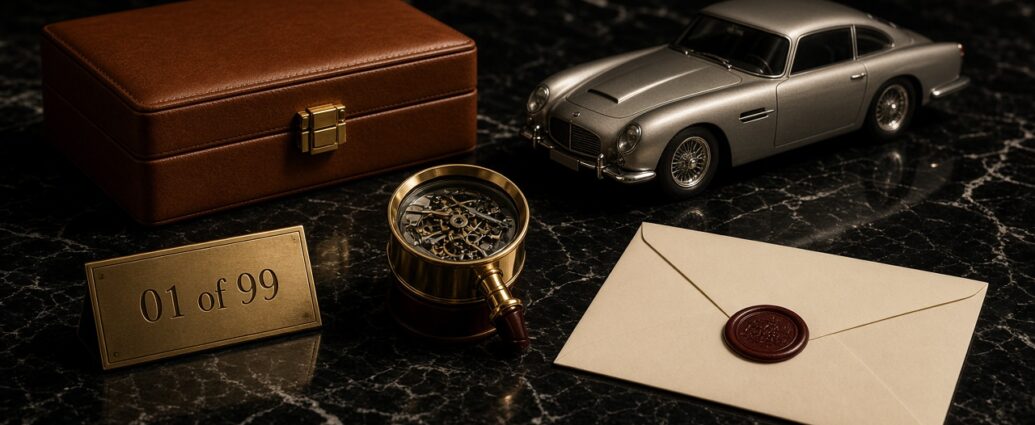
Hermès, Patek Philippe, Audemars Piguet, Richard Mille, Rolls-Royce Coachbuild, Ferrari Icona, Pagani, Bugatti — and the drop culture that copied their manners. Scarcity, with the numbers attached.
The most exclusive houses in the world are not selling objects. They are selling a refusal. A bag you cannot put on a waitlist and pay your way into. A watch allocated by a retailer who already knows your name. A car whose production number was fixed before the public ever saw it. Scarcity, done properly, is not a marketing slogan. It is the business model. These are the houses that built that model — and the figures, where they have been disclosed, that show how tightly they hold it.
Hermès: the bag that is never on the shelf
The Birkin is the most famous un-limited limited edition in fashion. Hermès does not sell it as a numbered run, yet access behaves like one. Sotheby’s has said each Birkin is made by a single artisan, takes a minimum of 18 hours, and that those artisans train for around five years; Christie’s has put the work at up to 40 hours for a single expert craftsperson. Output cannot be scaled like a logo tote. In 2024, California shoppers filed a proposed class action alleging that the house reserved Birkins for clients with “sufficient purchase history.” The case was dismissed in September 2025. Reuters reported that U.S. District Judge James Donato wrote it may be that Hermès “reserves the Birkin bag for its highest-paying customers, but that in itself is not an antitrust violation.” The allocation survived the lawsuit. The mystique survived with it. We have already set this in the wider European shift toward invitation-only allocation, and in our primer on what actually makes a limited edition.
The watch houses: Patek, Audemars Piguet, Richard Mille
Patek Philippe has been unusually candid about who gets the scarce pieces. Asked by Forbes in 2019 how rare watches are assigned, president Thierry Stern said the brand allocates to its retailers, but “he has to choose his own clients” — the “serious buyers” who will keep the watch, not flip it. In 2021 he went further. He told the Swiss newspaper NZZ he had discontinued the steel Nautilus 5711 because he did not want “a single model to suddenly make up 50% or more of our collection,” and did not want steel watches to exceed about a third of production. Ending a hit, on the record, to protect the house: that is scarcity as policy. The after-market is where the policy is priced; see our Watch Vault and Luxury Power Lists’ ranking of the most expensive watches ever sold at auction.
Audemars Piguet has played the same game at a slightly larger scale. Business of Fashion, in a portrait of the house’s growth past CHF 1 billion in revenue, reported that AP was limiting production at Le Brassus to 40,000 units a year — an elite volume by Swiss standards, and a self-imposed one. Richard Mille is smaller still. Les Echos reported 3,500 pieces in 2016 and 4,000 in 2017; the Fondation de la Haute Horlogerie later put 2018 output at 4,600, with a then-target of 5,200 for 2019. WatchPro, quoting Richard Mille, described a market in which three customers were chasing every watch, and a 70-piece McLaren RM 50-03 that sold out at a million dollars each before it officially went on sale. These are not mass luxury names. They are quotas with a movement inside.
A limited edition is a number the house is willing to publish, then honour. The great ones treat that number as a contract with the people who already got in.
Coachbuild and the hypercar cap
Rolls-Royce revived coachbuilding as a private art. The Boat Tail was announced as a trio, each car commissioned for a different client. The Droptail, the company has said, is a run of four; the Sweptail was a single example. That is not a product line. It is a sequence of unique commissions, priced in the stratosphere and never intended for a showroom crowd.
Ferrari made the logic industrial, and still tiny. The Icona series began with the Monza SP1 and SP2, limited to 499 units across both versions; Bloomberg reported that Ferrari hand-picked 499 of its most loyal customers, one car each, at about $1.85 million, and that the run was assigned to named buyers. The F80, unveiled in October 2024, is a limited run of 799 “intended for the most discerning clients of the brand,” and Reuters reported it had already sold out on the day of its reveal. Pagani is even more explicit. The Utopia coupé was announced as 99 cars and, Pagani said in 2023, had sold out. Horacio Pagani has said the company “chooses customers.” Bugatti writes the cap in public: the Chiron was limited to 500, the Tourbillon to 250, the Centodieci to ten. We have already been inside that last number in Only 10 Exist Worldwide.
The drop, and the face that sells it
Fashion learned a faster version of the same grammar. The 2017 Louis Vuitton collaboration with Supreme became the textbook drop: a house collection that vanished at retail and reappeared, immediately, at a premium. The object was a box logo. The product was the ration. Scarcity here is not a decade of artisan hours. It is a release window, closed on purpose.
The face in the campaign is often doing the same work as the allocation list — inviting you into a world that is almost closed. That is why women in luxury ads still make the till ring, and why a European closet can be staged as a limited drop, as EuroCelebs noted when Emily in Paris’s Sylvie opened her Paris wardrobe. Global Celebrity Meter’s account of how a famous name is priced is the other side of the same coin. The houses at the top of this list do not need to shout. They need to choose. The Concierge Vault is built on that language of invitation, not inventory. If you have to ask whether a brand belongs on a limited-edition list, it probably does not. The ones that do have already decided who is allowed to buy.


1 Comment