
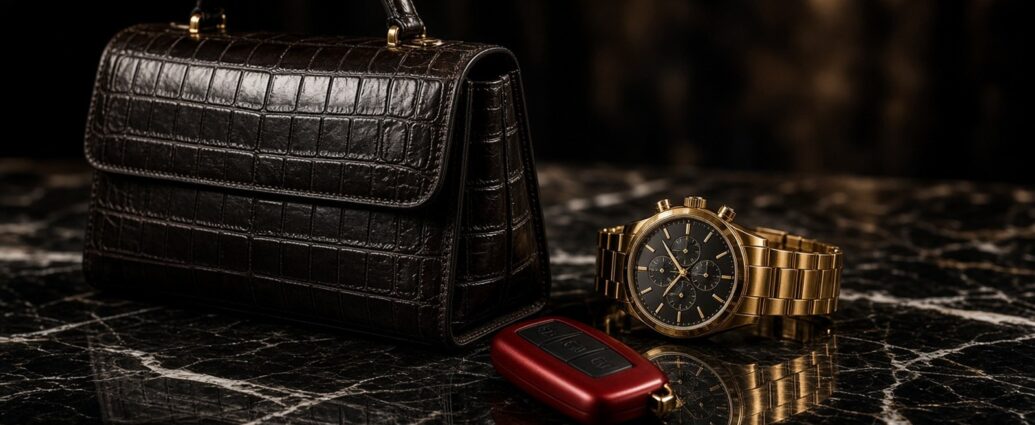
“Limited edition” is one of the most overused phrases in luxury. A trainer collaboration printed in tens of thousands can carry it, and so can a hypercar of which only 63 will ever exist. The difference lies in how scarcity is built: who decides how many are made, who is allowed to buy them, and what buyers agree to before they can take one home. This explainer looks at the mechanics behind genuine limited editions in fashion, cars and watches, and why those mechanics push values up long after the first sale.
The five building blocks of a true limited edition
Most serious limited editions share some or all of these features. Ranked from most to least important for long-term value, they are:
- A fixed, public production number. The maker announces exactly how many will be built and does not add more. A plaque, case-back engraving or certificate showing “No. 12 of 99” is the strongest guarantee of rarity.
- Client selection. The maker chooses buyers, usually from existing customers, rather than selling to whoever arrives first.
- Allocation instead of open sale. Units are allocated before production, or even before the public reveal, so the open market never sees a new example at retail.
- Resale restrictions. Contracts can forbid or penalise quick resale, keeping speculators out.
- Craft constraints. Some products are scarce simply because skilled hands can only make so many, whatever the demand.
Hermès: scarcity through craft and purchase history
Hermès does not label the Birkin or the Kelly as limited editions, yet in practice they behave like one. Two forces are at work.
Craft hours
Each Birkin is made by a single artisan. Sotheby’s says it takes a minimum of 18 hours to complete and that artisans train for around five years. Christie’s puts the figure at up to 40 hours for a single expert craftsperson. Sources: Sotheby’s Birkin guide and Christie’s Hermès collecting guide. Because output depends on trained hands, it cannot grow quickly. Exotic skins tighten supply further. A Himalaya, in Niloticus crocodile hand-dyed to fade from grey to white, is among the hardest to obtain.
Purchase history and the quota question
Shoppers and resellers have long described an informal system in which boutique staff offer Birkins only to clients with a strong record of buying other Hermès products. In 2024 two California shoppers sued Hermès in a proposed antitrust class action, alleging that the company tied access to Birkins to purchases of other goods, as Reuters reported. Hermès disputed the claims, and court records show the federal antitrust claims were dismissed with prejudice in September 2025. Whatever the legal outcome, the case put a public spotlight on how much “who you are as a client” governs access to the most-wanted bags.
Ferrari: numbered series and handpicked clients
Ferrari runs the most structured limited-edition system in the car world. It sells several tiers of special series, each with a declared production number.
The supercar line: LaFerrari and F80
Ferrari’s flagship “supercars” appear roughly once a decade. LaFerrari was limited to 499 coupés, and Ferrari built one extra, the 500th, to raise funds for victims of the 2016 earthquake in central Italy, according to Ferrari. Its successor, the F80, will be built in 799 units. Ferrari says the cars were allocated to clients before the public reveal, per its corporate announcement.
The Icona series: Monza SP1 and SP2
In 2018 Ferrari launched a new category called Icona, which reinterprets classic racing cars for a small circle of collectors. The first models, the single-seat Monza SP1 and two-seat SP2, were limited to 499 units across both versions. Bloomberg reported that Ferrari hand-picked 499 of its most loyal customers, with one car per client, for a model priced at about US$1.85 million, and that the whole run was assigned to named buyers. That makes Monza a clear example of allocation before sale, as Bloomberg reported.
How Ferrari picks buyers
Ferrari does not publish a formal checklist. The signals most often cited by dealers and collectors are how many Ferraris a client has bought, whether they have kept them, whether they take part in factory events and whether they have flipped earlier allocations. The result is a pyramid. New customers buy series-production models, and only long-standing clients are invited up to the Icona and supercar tiers.
Lamborghini: “Few-Off” cars with symbolic numbers
Lamborghini often chooses production numbers that tell a story. The Sián FKP 37, the brand’s first hybrid, was limited to 63 units, a reference to the company’s founding year of 1963, according to Lamborghini. The Countach LPI 800-4, a modern tribute to the 1970s original, was built in just 112 units, according to the Lamborghini model page. The numbers make each car a numbered collectible from the moment it is announced. Lamborghini calls these cars “Few-Off” models, a step above its regular series production.
Bugatti and Pagani: small makers, hard caps
For the smallest hypercar makers, scarcity is built into the business model. Bugatti capped the Chiron at 500 cars and built the final example, the Chiron Super Sport “L’Ultime”, in 2024, closing that chapter for good, according to the Bugatti newsroom. Pagani announced its Utopia coupé as a run of 99 cars and said it had sold out, as recorded in Pagani’s 2023 press release. With caps that low, almost every buyer is a known collector, and the secondary market sets the price from then on.
Watches: Rolex and Patek Philippe allocation
Waitlists that are not really lists
Steel sports watches from Rolex and Patek Philippe are not officially limited editions, yet for years they were almost impossible to buy at retail. Authorised dealers allocate scarce models to clients they know, much as Ferrari dealers do. Rolex has publicly rejected the idea that this is deliberate. In a rare statement it said that “the scarcity of our products is not a strategy” and that it was not willing to compromise on quality to raise output, as reported by Time+Tide.
Ending a model to protect a brand
Patek Philippe took a more radical step in 2021 when it discontinued the steel Nautilus 5711, then perhaps the most wanted watch in the world. President Thierry Stern told the Swiss newspaper NZZ that he did not want “a single model to suddenly make up 50% or more of our collection and dominate Patek’s image”. He added that the brand also had an obligation to its customers, and said he did not want steel watches to exceed about a third of production. Ending production turned every existing 5711 into a closed series overnight.
True limited editions in watchmaking
Alongside allocation, watchmakers produce genuinely numbered runs. Independent houses such as F.P. Journe and George Daniels made famously small series, and charity pieces such as those made for Only Watch are often unique. These are the watches that tend to set records, as our ranking of the greatest record sales of yesteryear shows.
Resale clauses: the contract behind the car
Some makers protect their editions in writing. The best-known case involved the wrestler and actor John Cena. Ford’s 2017 GT came with an agreement that buyers would not resell the car within 24 months. Ford sued Cena after he sold his early, seeking damages that included the profit from the sale. The two sides settled in 2018, and the money went to charity, according to Automotive News. Clauses like this, along with the unwritten rule that a client who flips an allocation will not be offered the next one, are why makers can keep a tight grip on where their cars go.
Why scarcity drives value
Put the mechanics together and the economics are simple. When supply is fixed and public, every buyer knows that no more will be made. When the maker picks clients, the first owners tend to be collectors who keep their pieces, so few reach the market. When resale is discouraged, the examples that do surface carry a premium. And when production depends on craft hours, as at Hermès, supply cannot expand to meet demand even if the maker wanted it to.
Scarcity alone is not enough, though. A numbered edition of something nobody wants stays cheap. The objects that rise in value combine genuine scarcity with design, history and desire, which is why the same principles apply to contemporary art editions. Our coverage of Rana Begum’s work and the Enzo Art Fair shows how the art world handles the same questions.
If you are thinking of buying or selling, our guide to limited-edition auctions covers fees, authentication and tax, and our guide to the biggest auctions happening in France lists the key dates for the coming season.
Related reading
- Limited-Edition Auctions: How to Buy and Sell Watches, Bags and More
- Records of Yesteryear: The Greatest Limited-Edition Auction Sales
- How to Sell Art and Memorabilia: Auction, Private Sale or Gallery
Frequently asked questions
What officially counts as a limited edition?
There is no single legal definition. In practice, a limited edition has a fixed production number announced by the maker, ideally with each piece individually numbered and recorded.
Is the Hermès Birkin a limited edition?
Not officially. It is made in ongoing production, but craft hours, exotic skins and selective boutique allocation keep it scarce in practice. Some special Birkins are made in genuinely limited numbers.
How does Ferrari choose who can buy a limited model?
Ferrari does not publish its criteria, but special series such as the Monza SP1 and SP2 and the F80 are offered to selected existing clients, usually those with long ownership histories.
Can a carmaker stop me reselling my car?
Some purchase contracts include no-resale periods. Ford’s GT agreement did, and Ford took legal action against John Cena when he sold early, before the two sides settled.
Does a limited edition always rise in value?
No. Scarcity helps, but values rise only when demand exceeds supply. Design, provenance, condition and brand strength matter as much as the production number.


4 Comments