
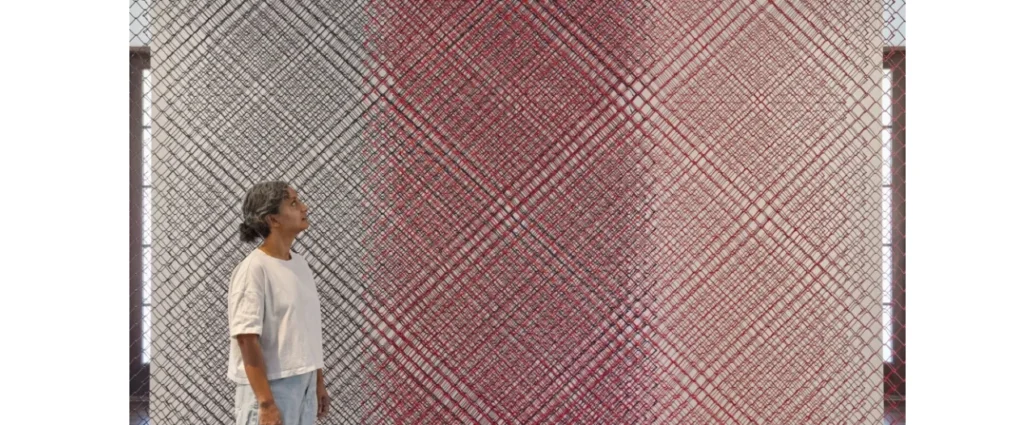
Born in Bangladesh and raised in Hertfordshire, England, Rana Begum never imagined art could become her career. Her father worked multiple jobs to provide for the family and moved them to the UK in search of better opportunities. When Begum arrived in 1983, she did not speak English. To keep her engaged in class, her teachers handed her colored pencils—an act that unknowingly shaped her future. Art soon became her language, a bridge to connect with others in a new country.
Encouraged by her teachers, Begum enrolled in introductory art courses. Though her parents were initially hesitant, support from a visiting uncle convinced them to allow her to pursue her creative interests. When she secured an interview at Chelsea College of Arts in London, her father hired a van to transport her portfolio—a gesture of quiet but powerful belief. She earned her BA in 1999 and later completed an MFA in painting at the Slade School of Fine Art in 2002.
Over the years, Begum’s work has traveled internationally. Her exhibitions have been showcased at major venues, including the Long Museum in Shanghai and the Whitechapel Gallery in London, and she participated in the 2016 Gwangju Biennale. In 2020, she was elected a Royal Academician. However, one of the most meaningful milestones for her family came in 2014, when her work was presented in Bangladesh during the Dhaka Art Summit.
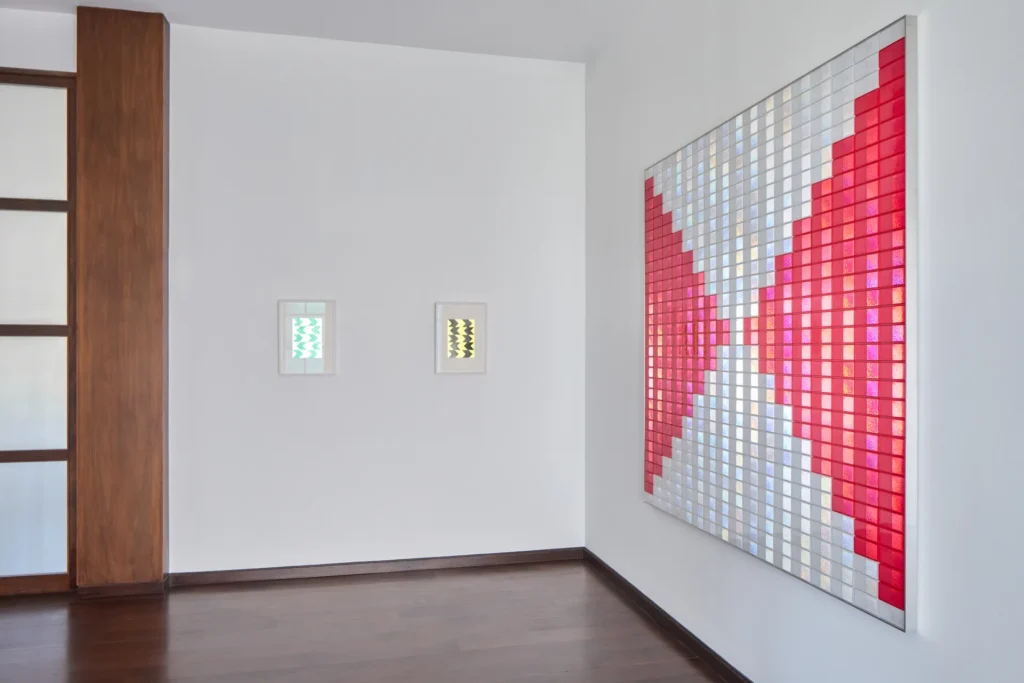
Begum’s artistic language is rooted in abstraction, often using industrial materials to create refined geometric compositions. Her work blends the disciplined aesthetics of American Minimalism with the patterns and repetitions found in Islamic architecture and design—visual influences from her upbringing.
Currently, her exhibition “Reflection” is on view at the Gallery at Windsor in Vero Beach, Florida, through May 8. The exhibition previously debuted at the SCAD Museum of Art at the Savannah College of Art and Design, marking her first major institutional presentation in the United States. Curator Daniel S. Palmer, who first encountered her work about a decade ago in Dubai, has long admired her exploration of light and color.
Founded in 2002, the Gallery at Windsor has hosted globally recognized artists such as Christo and Jeanne-Claude, Peter Doig, Jasper Johns, Grayson Perry, and Ed Ruscha. Located within Windsor, a 472-acre oceanfront community established by Canadian philanthropists Galen and Hilary M. Weston, the gallery operates by appointment and supports charitable initiatives.
One standout piece in the exhibition, No. 827 (2018), exemplifies Begum’s fascination with perception. At first glance, the work appears as a simple painted surface. In reality, it consists of 30 tall metal bars arranged tightly together. Painted white on top and accented with soft shades of pink, lavender, and blue along the sides, the structure transforms as viewers move past it. Reflected light subtly shifts the colors, creating an optical interplay that makes the artwork feel kinetic—without any physical motion. The viewer’s movement becomes integral to the experience.
Begum has spent years studying color, striving to create work that embodies change. Interestingly, she discovered that the colors seemed to blend within the viewer’s eye, producing unexpected visual effects that even surprised her.
Her practice also resonates with the legacy of American Minimalism, drawing comparisons to artists like Anni Albers, Dan Flavin, and Agnes Martin. Growing up in a Muslim household, Begum participated in communal Quran readings, where repetition plays a central role. That rhythm and structural repetition continue to echo in her work.
Another notable piece, No. 1272 Chainlink (2023), features layers of powder-coated fencing suspended from the ceiling. Colored in deep reds and blues, the overlapping sheets create shifting tonal variations as viewers move around them. Inspired in part by sculptor Anne Truitt and painter Mark Rothko, Begum translated minimalist concerns into materials encountered during her time in the Coachella Valley for the 2023 Desert X Biennial.
Through industrial materials, precise geometry, and a masterful understanding of light, Rana Begum creates art that feels both powerful and luminous—solid yet constantly shifting in perception.

2 Comments